
Delta Media Group
Delta Media Group is the quiet giant of real estate brokerage technology, websites, and digital marketing. For decades, the company has flown below the radar, selfishly focusing on innovation to address its clients’ current – and future – needs.
Today, under the leadership of owner and CEO Michael Minard, Delta Media has created a center of excellence for brokerages by inventing a Hall-of-Fame-caliber list of real estate technology solutions, remarkably appropriate for a firm based in the Canton, Ohio, area. Home to the Pro Football Hall of Fame.
With the launch of its newest core offering, DeltaNET 7, Delta Media has redefined the future of real estate brokerage technology with an unmatched all-in-one platform, including the industry’s easiest-to-use CRM, digital marketing tools, superpowered SEO, and a web platform that redefines automation, flexibility, and ease of use. After an investment of 40,000 development hours and $40 million, DeltaNET fuses automation and AI (artificial intelligence) to develop cutting-edge broker websites that offer agents and teams state-of-the-art solutions backed by superior tech support.
Delta Media’s history includes an abundance of firsts. From creating the technology that powered the first online property searches for brokerages (its PropertyPursuit search engine) in 1994 to a platform that allowed brokerages to control their data distribution fully, decades before Project Upstream, Delta was a leading innovator.
Early tech pioneer with innovation that endures
Established in 1994, Delta Media Group began as The Delta Group, based in Beaverton, Oregon. Owned by Wayne Mangold, Delta was an early internet innovator for the real estate industry.
Delta's mantra was “providing information solutions to a world in constant change.” That led to Delta fueling the online presence of early brokerage pioneers, including Barbara Sue Seal Properties (Lake Oswego, OR), Hasson Company Realtors (Lake Oswego, OR), and Century 21 Champions (Beaverton, OR).
Amazingly, the core technologies developed by Delta at its inception are still used today, including Delta's "Door Technology" as well as its “Property Pursuit” property search engine.
Enabling online property search
“High-tech House Hunting” was the headline of the full-page feature the Oregonian ran a week before Christmas Eve on Dec. 17, 1994, as they wrote about Delta’s early efforts:
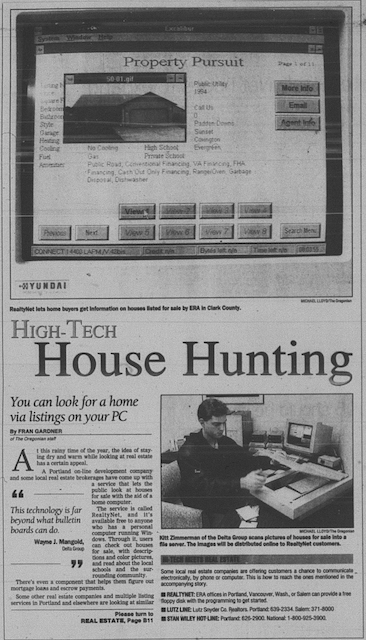
“A Portland online development company and some local real estate brokerages have come up with a service that lets the public look at houses for sale with the aid of a home computer. The service is called RealtyNet, and it's available free to anyone who has a personal computer running Windows. Through it, users can check out houses for sale, with descriptions and color pictures, and read about the local schools and the surrounding community.”
Over the next couple of years, Delta would rapidly expand to become the largest service provider of online, dedicated information systems for the real estate industry. The Delta information system uniquely provided strategic information, marketing, and business systems for brokerages and agents – including Barbara Sue Seal Properties, Hasson Company Realtors, and Jack Tate Real Estate – to promote the syndication of listings on generic websites.
A pivotal year and a name change
In 1998, the Delta Group Founder, Mangold, partnered with Chi Chi Cao. Emboldened with new funding, the company relocated to Sunnyvale, CA, re-branded as Tigerfly, Inc., and significantly expanded its operations.
Over the next two years, Tigerfly operated as a B2B provider of real estate services. Its focus was two-fold. First, Tigerfly helped real estate brokerages and franchises take their businesses online. Second, the company was developing a new e-marketplace, an online National Multiple Listing System Platform that larger brokerages would own and control, called an Exchange.
Tigerfly’s overarching goal was to transform "brick-and-mortar" real estate companies into an e-marketplace, or Exchange. The platform that Tigerfly built would put real estate brokerages in control of their data. While the TigerData Exchange was built and ready for beta by the end of 2000, it never launched after the dot-com bubble burst.
TigerData was nearly identical to Project Upstream, now being brought to market by CoreLogic. The TigerData Exchange would put real estate firms in complete control of their data, enabling them to monetize it rather than allowing Multiple Listing Services (MLSs) to do so.
Transforming back to Delta and rapid growth
In the fall of 2000, current owner and CEO Michael Minard, along with three other business partners, purchased TigerFly. The company was re-branded as Delta Media Group and relocated to Barberton, Ohio.
During these first few tumultuous years, under Minard’s leadership, the Delta Media team migrated the Tigerfly core platform from a Windows Server .NET to a LAMP architecture (Linux, Apache, MySQL, PHP) to expand technology offerings and features.
From 2001 to 2007, Delta Media began a growth spurt in product offerings, client acquisition, and revenue. What started at the turn of the century as a team of three rapidly grew to more than 50 members. Property listings surged from 14,000 active listings in its database in 2001 to more than 4 million properties for sale across 48 states in 2007.
Hallmarks of innovation
Delta Media’s renewed success was a result of its penchant for innovation. Once again, decades before the trend, Delta Media Group launched the first version of its private cloud platform in 2001. Moving its new platform to the cloud created the ability to scale massively. Its cloud-based platform would ultimately service over 100 million visits per month and handle billions of daily database queries.
It was Delta Media Group that, in 2003, brought Optical Data’s blazing speed capabilities to the Belden Village, Stark County, Ohio area. Delta Media’s OC-3 connectivity – with speeds 150 times current standards -- helped to fuel its rapid growth.
By 2008, Delta’s growth had exploded fivefold. At the dawn of the Great Recession, Delta Media moved into its new corporate headquarters in Canton, Ohio, a multi-story, 30,000-square-foot Class A+ office building. Custom-built for Delta Media, the modern facility still houses corporate offices and a 7,000-square-foot state-of-the-art data center, one of Ohio’s most advanced hosting centers.
Weathering the Great Recession
While the Great Recession technically lasted for only two years – 2007 to 2009 – its profound and far-reaching impact on the real estate industry continued well into 2012. It was a time when Delta Media, like most real estate technology providers, experienced significant client loss. Yet Delta Media maintained its overall client totals through effective new-client acquisition. While growth remained flat throughout these years, Delta Media remarkably weathered the Great Recession.
Delta Media remains poised for future growth through continued product innovation and iteration. While most of its competitors struggled to survive, Delta was able to re-engineer much of its legacy platform while continuing its technology inventions. This helped propel Delta Media to a stronger position within real estate as a technology and marketing solutions provider.
Minard launched Delta into the Digital Marketing services by creating new systems for Search Engine Optimization (SEO).
The next era of growth and innovation
Delta Media began showing signs of accelerated growth by the end of 2014. Delta Media had focused on improving internal processes and developed systems to reduce its operational costs and speed up operational launches for new clients.
It was also the year that Delta Media launched its Properties In Motion technology, which combines the power of video with intelligent marketing, allowing property listings to achieve top search engine rankings.
2015 marked a year of cutting-edge development for Delta Media as it launched several new core products, including DeltaNET 5, a new theme engine to replace its template web system, and its latest CRM version. A significant personal loss marked the year as one of the original owners, friend to the company, and business mentor to Minard, James L. Bray, passed away at the age of 75.
Delta becomes 100% family-owned
On Friday, Sept. 2, 2016, Minard bought out his remaining business partners and became the sole owner of all Delta Media stock. That strategy, Minard maintains today, has been Delta Media’s most important competitive advantage, providing benefits that companies with outside investors or obtained VC (Venture Capital) funding can’t match.
Minard points to the historical experience of his firm, Delta Media, which almost went out of business during the “dot-com” boom. Then known as TigerFly, the investor-dollar-funded firm was unable to secure its next round of funding as VC dollars ran dry. This was when Minard and three others purchased the company and re-branded it as Delta Media Group.
“It's a perfect example of what can happen when you rely on investment funding,” says Minard in a video chat about the unique advantages to Delta and its clients of being 100% family-owned.
Minard admits he contemplated securing VC funds in 2016, just before he purchased all of Delta’s shares from his business partners. Delta has been profitable every year of Minard’s ownership since 2000, and he wanted to grow the firm rapidly. He determined the best way to do that was to take full ownership.
Why having no VC funding is a major business advantage
The credo that drives Minard's decision to avoid outside funding and remain 100% family-owned today hangs on the wall of his office. It says, “Be willing to grow slowly to survive.”
Most of Delta’s competitors have turned to VC funding to fuel rapid expansion. Minard notes that the technology platform Delta Media built and its ability to grow over the last two decades have put it in a unique position as a real estate tech leader that doesn’t need outside funding to thrive.
“We all know stories of VC-funded companies in real estate that grew too quickly and then crumbled under their own weight,” Minard said.
Another common trend among VC-funded competitors, Minard points out, is that those who, in their thirst to grow, have been acquired and rolled up into other firms, disrupting clients and their brokerages.
Many of these firms’ CEOs were looking for an exit strategy. That’s something Minard reveals he has no plans to do. “We just don’t need VC funding. Delta is long-term; we are going to be around as a family-owned business. If I wanted to exit, I could have exited in the last two years.”
VC-funded companies must take the opposite approach, Minard points out, as VC dollars come with a built-in exit plan. “It’s typically a 3- to 5-year exit,” Minard said. VC-funded businesses are under pressure to pay back investors first, he notes. Delta Media, as a family-owned company, can focus on its clients first – and create a better long-term environment for its team members. They are even including a no-sell guarantee in their contracts.
Unlike a VC-funded competitor with high employee turnover and poor Glassdoor reviews, Minard was created by Delta Media, a firm with low turnover and stellar employee reviews. "I want our team members to be able to retire from Delta Media,” Minard said.
The advantage for brokerages
Minard explains that Delta Media already reinvests millions of dollars every year into its tech development. The most prominent example is its DeltaNET 7 platform, born of 40,000 development hours and a $40 million investment.
Delta Media also applies its tech development resources internally to automate its systems and processes. This makes Delta Media more agile than competitors with twice the staff, faster to market with client launches, and speedier to respond to client needs.
When the pandemic hit in March 2020, Delta marshaled its development resources to focus on offering integrated Virtual Open Houses to its clients as a new feature on its DeltaNET platform in a matter of weeks. When Zillow announced its acquisition of ShowingTime in 2021, Delta once again pivoted to meet an outpouring of client and industry requests to invent Local Showing, rolling out a new app and platform fully integrated into DeltaNET in less than 80 days.
"There is a myth that, as a real estate technology company, you have to raise capital to be competitive. You don't," Minard said. He notes Delta Media has weathered two recessions and is not looking for outside funding because Delta Media does not need it, and he doesn’t want that business model for his firm. “And when the next recession comes, I would not want to be with a company that owed VC-investors millions of dollars.”
With new developments in AI and automation, Delta Media plans to grow as much as “tenfold” over the next few years, which Minard believes will help clients in profound ways. To accomplish this, he said Delta Media would continue to focus on its core strength – being an innovative technology partner that clients can trust rather than merely a tech vendor.
Media contacts:
Kevin Hawkins · (206) 866-1220 · kevin@wavgroup.com