
Subscribe and receive email notifications of new blog posts.
 RSS Feed
- 2026 | 71 Posts
- 2025 | 96 Posts
- 2024 | 114 Posts
- 2023 | 143 Posts
- 2022 | 188 Posts
- 2021 | 204 Posts
- 2020 | 190 Posts
- 2019 | 118 Posts
- 2018 | 122 Posts
- 2017 | 164 Posts
- 2016 | 95 Posts
- 2015 | 68 Posts
29
The Power of DeltaNET®: How Delta Media Group® Is Revolutionizing Real Estate With New AI Tools
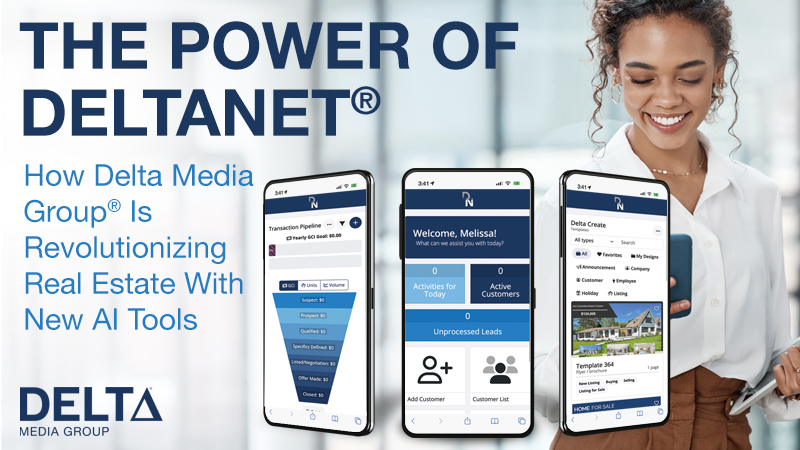
With rapid technological advancements, the real estate industry is undergoing a seismic shift that is reshaping how agents and brokerages operate. Delta Media Group has been at the forefront of this transformation, constantly inventing new tools and features to keep real estate professionals evolving.
Delta Media Group's latest step in improving real estate operations through technology involves rolling out a brand new suite of artificial intelligence (AI) tools in the most advanced version of our all-in-one CRM platform yet, DeltaNET 7. By focusing on user-specific context, task-specific AI engines, and seamless integration, Delta aims to deliver tools that are both powerful and intuitive. These AI tools are designed to enhance productivity, personalize user experiences, and streamline operations. Crafted to address the unique challenges faced by agents, these tools will redefine how real estate professionals engage with clients, manage listings, and market properties.
The Evolution of AI at Delta Media Group
Delta Media Group's journey with AI began over two decades ago, reflecting a commitment to staying ahead of technological curves. From 2000 to 2013, Delta implemented what it refers to as "early AI" solutions, which, while rudimentary by today's standards, were groundbreaking at the time. These included software-driven AI for search engine optimization (SEO), enabling Delta's platform to rank higher on search engines, and AI for MLS data translations, which standardized disparate data formats for seamless integration. Additionally, Delta developed AI for data scraping detection, a system that identified and mitigated unauthorized data extraction by recognizing patterns and anomalies.
In 2013, Delta launched the "My Customer for Life" (MCFL) program, a significant milestone in its AI journey. MCFL is an AI-driven newsletter system that analyzes recipient behavior to deliver individualized email content. With tens of millions of emails sent monthly, MCFL demonstrated Delta's ability to scale AI solutions effectively. By 2018, Delta collaborated with North Carolina State University's Institute for Advanced Analytics to develop a lead scoring and distribution engine. This AI model achieved over 90% accuracy in predicting which leads would transact within 30 days and identifying the optimal agent for each lead. However, due to high operational costs, the full implementation was limited to a lead scoring engine launched in 2019.
Despite these advancements, Delta's leadership, led by CEO Michael Minard, recognized limitations in their initial AI approach for DeltaNET 7. In July 2024, a planned AI launch was halted because the tools were deemed too generic, lacking the personalization and context needed to serve agents effectively. Mike noted that the initial tools followed a "cookie-cutter" approach, similar to competitors' offerings, which failed to account for the unique identities and needs of individual agents, teams, or brokerages. This realization prompted a strategic overhaul, resulting in a more sophisticated, user-centric AI framework that forms the backbone of DeltaNET 7's new tools.
A New Approach to AI Integration
Delta's revamped AI strategy is built on three core principles: personalization, task-specific engine selection, and seamless integration. These principles address the shortcomings of earlier AI implementations and align with the needs of modern real estate professionals.
1. Personalization
Unlike traditional AI tools that treat all users identically, DeltaNET 7 creates a unique profile for each user — whether a real estate company, office, team, or individual agent. This profile captures critical details such as the user's market focus (e.g., luxury real estate, first-time buyers), brand identity, and clientele demographics. By embedding this context into AI interactions, Delta ensures that outputs, whether content, lead responses, or search results, are tailored to the user's specific needs. For example, an agent specializing in high-end coastal properties can configure the AI to reflect this focus, resulting in marketing materials and lead responses that resonate with their target audience and better represent that specific agent.
2. Task-Specific Engine Selection
Recognizing that no single AI engine excels at all tasks, Delta has integrated multiple engines, each chosen for its strengths in specific areas. The company has incorporated various versions of Claude (developed by Anthropic), OpenAI's models (including ChatGPT variants), Google's AI offerings, Meta's AI, and lesser-known engines like Mistral and Hugging Face. For instance, Claude is leveraged for coding tasks due to its precision in generating and debugging code. At the same time, OpenAI models are preferred for content creation, such as blog posts and emails, due to their natural language proficiency. This multi-engine approach ensures optimal performance and allows Delta to adapt to new AI developments as they emerge.
3. Seamless Integration
Delta's AI tools are designed to be unobtrusive and genuinely helpful, avoiding the pitfalls of intrusive AI implementations. Apple's AI can be used as an example of what to avoid, noting its tendency to disrupt workflows with unhelpful suggestions. In contrast, DeltaNET 7's AI integrates seamlessly into existing workflows, enhancing productivity without requiring significant changes to how real estate agents operate. The tools are accessible through intuitive interfaces, such as an AI button within widgets, and are supported by prebuilt prompts that simplify interactions for users unfamiliar with AI.
Key AI Features in DeltaNET 7
DeltaNET 7 introduces a suite of AI tools designed to address the diverse needs of real estate professionals. Below are the platform's key AI features, their functionalities, and their potential impact.
1. Personality and Context Tool
The personality and context tool is the cornerstone of DeltaNET 7's AI suite. It creates a default profile for each user, capturing their professional identity, market focus, and brand. This profile serves as the foundation for all AI interactions, ensuring that outputs are tailored to the user's unique characteristics. For example, a brokerage focusing on urban condos can configure its AI profile to prioritize content and lead responses that highlight city living, modern amenities, and proximity to cultural hubs.
Users can further customize their profiles to refine AI outputs. For instance, an agent might specify that they target first-time homebuyers in a specific county, prompting the AI to generate content and responses that emphasize affordability, financing options, and local school districts. This level of personalization ensures that AI tools align with the agent's brand and market strategy, enhancing client engagement and trust.
2. Content Creation
From writing blog posts to crafting webpage content and email campaigns, content creation is a time-consuming task for real estate professionals. DeltaNET 7's AI tools streamline this process by generating high-quality, context-aware content with minimal user input. For example, an agent can request a blog post on "The Home-Buying Process for First-Time Buyers," and the AI will produce a detailed article outlining each step, complete with relevant imagery and formatting. The content is tailored to the agent's profile, ensuring it reflects their voice and market focus.
The AI also supports interactive content creation, allowing users to refine outputs. For instance, an agent might review a generated blog post and request the removal of a specific section or the addition of local market insights. This interactive process reduces the need for extensive manual editing, saving time and ensuring the content meets the agent's standards. Additionally, the AI can generate webpage content, such as landing pages for specific property types, and email campaigns, such as newsletters or drip campaigns, all customized to the user's brand.
3. Lead Responses
Effective lead management is critical in real estate, where timely and personalized responses can make the difference between securing a client and losing them to a competitor. DeltaNET 7's AI-driven lead response tool generates tailored responses based on the user's profile and the lead's context. For example, suppose a lead inquires about luxury homes. In that case, the AI can craft a response that highlights the agent's expertise in high-end properties, includes relevant listings, and uses language aligned with the agent's brand.
The tool also supports automation, allowing agents to set up rules for responding to leads based on specific criteria, such as inquiry type or geographic location. This automation reduces response times, improving the likelihood of converting leads into clients. By leveraging multiple AI engines, Delta ensures that responses are not only timely but also compelling and professional, enhancing the agent's ability to build rapport with potential clients.
4. Image-Based Property Search
One of the most innovative features in DeltaNET 7 is the AI-powered image-based property search. This tool allows users to query properties using natural language, such as "Show me homes with an open floor plan and a newly remodeled kitchen in Jackson Township with wood flooring." The AI analyzes listing images and associated data to identify properties that match the criteria, delivering results with high accuracy. While the tool is not yet 100% accurate, ongoing refinements are improving its performance.
This feature has significant implications for both agents and clients. For agents, it simplifies the process of finding properties that meet specific client needs, reducing the time spent sifting through listings. For clients, it offers a more intuitive and visually driven search experience, allowing them to describe their dream home in natural language rather than navigating complex search filters. The tool combines image recognition with data analysis, enabling it to identify features like open floor plans or remodeled kitchens based on visual cues and listing descriptions.
5. Listing Descriptions
Crafting compelling listing descriptions is a critical but time-intensive task for agents. DeltaNET 7's AI can generate detailed, engaging descriptions based on property details and photos. These descriptions often span three to five paragraphs, providing a comprehensive overview of the property's features, neighborhood highlights, and unique selling points. For example, a listing for a suburban family home might include descriptions of spacious living areas, proximity to top-rated schools, and recent upgrades, all tailored to the agent's brand and market.
The AI's ability to analyze photos enhances the quality of these descriptions. By identifying visual elements such as granite countertops or hardwood floors, the AI can incorporate specific details that make the listing more appealing. This feature saves agents significant time while ensuring that listings stand out in a competitive market. The generated descriptions are also editable, allowing you to make minor tweaks to align with their preferences or add personal touches.
Development and Testing
The development of DeltaNET 7's AI tools began in earnest in late 2024, following the decision to halt the initial launch. A key milestone was the adoption of Claude's enterprise engine for internal use by Delta's programming team. This move significantly boosted productivity, with senior developers reporting more than double their previous output. The team initially viewed AI as a task-automation tool but evolved to see it as a "junior programmer assistant," capable of handling complex coding tasks with proper prompting.
Delta's multi-engine approach required extensive testing to determine which engines performed best for specific tasks. The company developed internal tools to compare outputs from multiple AI models simultaneously, allowing developers to evaluate performance and refine integrations. This iterative process has been critical to ensuring that the tools meet the needs of real estate professionals.
The AI features are being launched as part of a beta program, with Delta actively seeking feedback from advisory committee members and early adopters. This feedback will drive continuous improvements, ensuring that the tools remain relevant and effective. The AI landscape is dynamic, with new engines and capabilities emerging weekly. Delta's ability to adapt to these changes positions it as a leader in AI-driven real estate technology.
Practical Applications and User Experience
DeltaNET 7's AI tools are designed with usability in mind, ensuring that agents of all technical skill levels can leverage them effectively. The platform incorporates intuitive interfaces, such as an AI button within widgets, that provide access to features like content creation and lead responses. Prebuilt prompts simplify interactions, offering suggestions for common tasks like generating blog posts or responding to leads. For example, an agent can select a prompt like "Create a webpage about the home-buying process" and receive a fully formatted page with minimal effort.
The iterative nature of the AI tools enhances their usability. Agents can review AI-generated outputs and request modifications, such as removing a section or adjusting the tone. This interactive process ensures that the final product aligns with the agent's vision. For instance, an agent might generate a blog post, review it, and ask the AI to emphasize local market trends, resulting in a revised version that better suits their needs.
The image-based property search is particularly user-friendly, allowing agents to input natural language queries via text or even SMS. For example, an agent can text the DeltaNET platform with a query like "Find homes with a pool in Miami," and the AI will respond with a list of matching properties, complete with links to detailed listings. This feature is accessible through the DeltaNET interface, ensuring that agents can use it on the go.
Industry Context and Challenges
The real estate industry faces numerous challenges, including low inventory levels, intense competition, and the need for efficient client engagement. DeltaNET 7's AI tools address these challenges by automating time-consuming tasks and providing personalized solutions. For example, the content creation and lead response tools reduce the administrative burden on agents, allowing them to focus on building client relationships. The image-based property search addresses the challenge of finding properties that meet specific client needs, particularly in markets with limited inventory.
However, implementing AI in real estate is not without challenges. One significant concern is the cost of AI operations, particularly for features like image-based property search that require extensive API calls. Delta is exploring pricing models to balance accuracy and affordability, potentially offering a free tier with limited usage and a paid tier for advanced features. Another challenge is ensuring AI outputs are accurate and reliable. This is why a human-in-the-middle (HIM) approach is best, noting that even the best AI engines can make errors, such as misidentifying a book chapter. Delta's approach includes robust testing and user feedback to minimize inaccuracies.
Future Implications and Industry Impact
The introduction of DeltaNET 7's AI tools has far-reaching implications for the real estate industry. By automating content creation, lead management, and property searches, these tools enable agents to operate more efficiently, freeing up time for client interactions and strategic planning. The personalization capabilities ensure that they can maintain a consistent brand identity, fostering trust and loyalty among clients.
The image-based property search has the potential to revolutionize how clients discover properties. By allowing users to describe their ideal home in natural language, the tool makes the search process more intuitive and engaging. This could lead to higher client satisfaction and increased conversion rates, as clients find properties that closely match their preferences.
Delta's commitment to continuous improvement ensures that the AI tools will evolve with the industry. As new AI engines and capabilities emerge, Delta plans to integrate them into
DeltaNET 7, keeping the platform at the cutting edge of technology. The beta program will play a critical role in this evolution, allowing Delta to refine features based on real-world usage and feedback.
Looking ahead, Delta envisions AI transforming other aspects of real estate operations. For example, the company is exploring AI-driven training courses and video content for DeltaNet Academy, which could streamline agent onboarding and professional development. Additionally, AI could enhance digital marketing platforms, potentially replacing tools like Canva by generating custom flyers and marketing materials with minimal input.
Delta Media Group's new AI tools in DeltaNET 7 represent a significant leap forward for the real estate industry. By prioritizing personalization, task-specific engine selection, and seamless integration, Delta is addressing the shortcomings of generic AI solutions and delivering tools that empower agents to succeed in a competitive market. The personality and context tool, content creation capabilities, lead responses, image-based property search, and listing descriptions offer practical solutions to common challenges, from time management to client engagement.
As these tools roll out in the coming weeks, Delta invites agents and brokerages to participate in the beta program, providing feedback to shape their development. With a deep understanding of AI's potential and a commitment to continuous improvement, Delta Media Group is poised to lead the industry into a new era of efficiency and innovation. The future of real estate is here, and DeltaNET 7's AI tools are at the forefront, ready to transform how professionals connect with clients and grow their businesses.