
Subscribe and receive email notifications of new blog posts.
 RSS Feed
- 2026 | 60 Posts
- 2025 | 96 Posts
- 2024 | 114 Posts
- 2023 | 143 Posts
- 2022 | 188 Posts
- 2021 | 204 Posts
- 2020 | 190 Posts
- 2019 | 118 Posts
- 2018 | 122 Posts
- 2017 | 164 Posts
- 2016 | 95 Posts
- 2015 | 68 Posts
23
On the Safe Side: A Q&A with Michael Walls
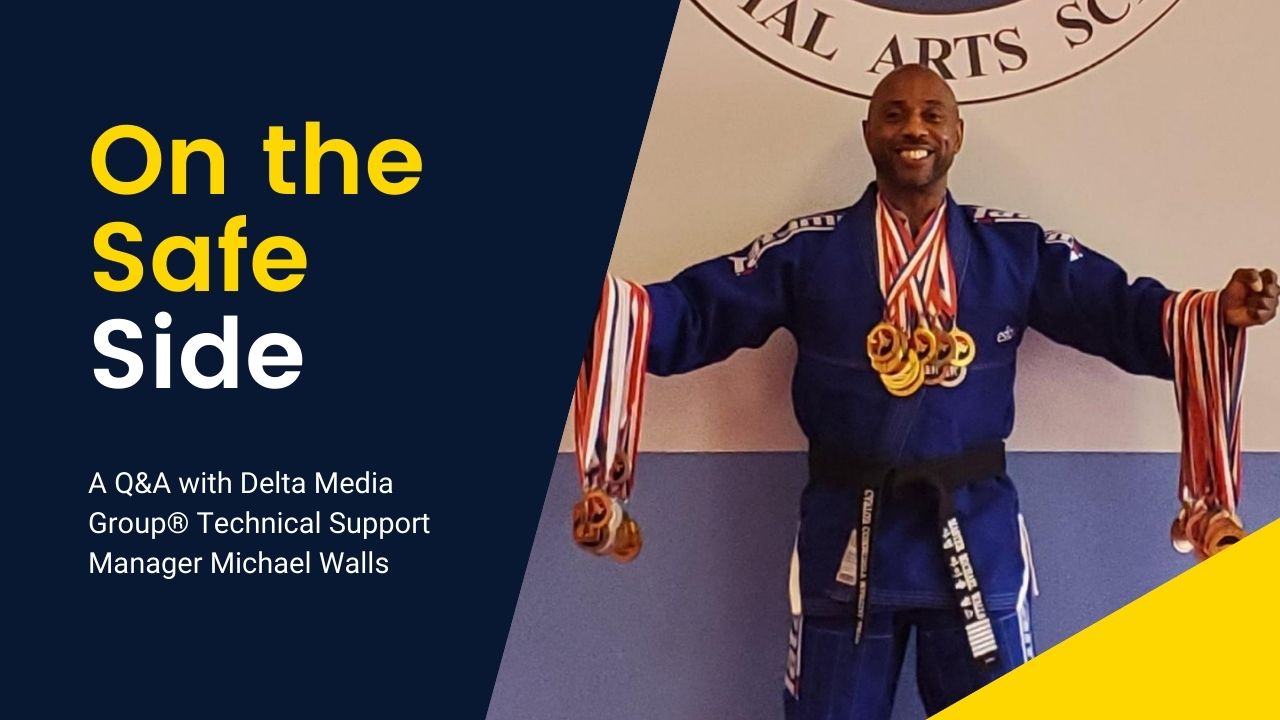
Michael Walls was walking through what he thought was, at the time, a totally normal showing when things took an unexpected turn.
Walls, who recently took over as Technical Support Manager at Delta Media Group® and is also a licensed real estate agent, said he felt "something strange...and one of the guys [at the showing] was being somewhat aggressive toward me." Luckily, Walls didn't have to worry about defending himself.
A sixth-degree black belt with nearly 40 years of experience teaching self-defense, Walls knew he had the situation well in hand. But while nothing came from the moment, Walls also knew that others in the real estate industry might not be so lucky. So, the wheels started turning, and an idea began to piece itself together.
No stranger to teaching the fundamentals of self-defense, Walls has welcomed students of all ages and abilities to his school, Canton Community Martial Arts School, since it first opened. With that experience in the back of his mind, Walls began to formulate a plan — teaching basic self-defense to real estate agents in Ohio's Stark County. Now, four years after that initial idea, Walls and the program are still going strong, helping area sales associates feel safe and confident no matter where they go.
The class meets once a month, with about 15 to 20 people attending each time, and Walls hopes to post instructional videos online eventually. It's also offered as a CE class, meaning sales associates who come get credit, which Walls says is another benefit. With REALTOR® Safety Month in September, Walls took some time to speak about the importance of his classes and how every sales associate should take steps to protect themselves.
What was the thought process behind starting the class?
As kids, you're taught don't get in a car with strangers, don't go anywhere with strangers, but then you get into real estate, and you're going into a vacant home with a stranger. So I said, "We need to start doing self-defense training or some kind of awareness training for real estate agents. And I'm sure it's been going on around the country, but we didn't have anything like that locally in Stark County. So I got with Collene Burgess, who was the head of Stark County Association of Realtors, and she told me that they were having safety classes and asked if I'd like to do it. I said, "Sure."
What's a typical class like? What do you start with? Especially if there are novices in attendance?
The first half-hour, I talk about certain safety things, and then we go over some self-defense moves. Most of it probably won't be remembered, but the things that I want them to gather are not the physical aspect of it but the awareness part.
A lot of times, your gut is your true instinct, and I always tell them, "If something doesn't feel right, don't ignore it. And if you happen to be wrong about that feeling, that's fine. But if that gut feeling is telling you something's wrong and you ignore it, you could be dead wrong." I come up with training tips for when you enter a home: not to turn your back, how you confront, how to stand if someone does get aggressive with you.
Learning the full scope of self-defense techniques, of course, requires more than one class, so are there little things sales associates can do to keep themselves safe in the field?
We work on those things, and we talk about safety tips that they can use on a day-to-day basis. When you open the door, your back shouldn't be turned to the person. When your client pulls up, get a picture of their license plate, get a picture of them, send it to a friend. You can do it from inside the house. Just take a picture, and they know who you're with.
Then we go over some statistics of what makes you vulnerable. And after that, when we've done that for about a half-hour, we'll go into basic strikes, self-defense strikes, basic stances, not to turn your back because...we show instances where you're backed into a room, and someone starts charging; the first thing people do is turn their backs. But if you've got long hair, [someone's] going to grab your hair. So, we work on hair grabs; we work on using different tools that we carry on a day-to-day basis.
I don't try to make it too difficult because they'll forget as soon as they walk out of the room. I try to make it as simple as I can.
Do you find that a lot of sales associates are surprised that self-defense is something they need on the job? Or is it more like, "Oh, I've been waiting for something like this?"
A lot of times, when they come there, they say, "Okay, it's a great course," but they have that sense of, "Well, it's not going to happen to me." And maybe that's a way of them not being afraid to do their job because if they thought about it, they probably wouldn't do it, and I think they push that aside. But I think that overall they enjoy it, they like it, and they're receptive to it.
What does it mean, especially with your real estate background, to have this course, teach it and impact people?
For me, I want to build safety awareness. Growing up with a single mother, I've always been protective of women, and I know that a lot of women are in the industry. What I hope they take from it is, like I said, being aware of their surroundings and being in tune with their instincts. When something's wrong, listen to your gut. And if you get into a situation, here's the best way to handle it.
Real estate is such an immediate sort of industry. You get a listing, and you have to jump on it. Knowing that, is there a sense from sales associates that, once they have a listing, they don't want anything to affect them from selling it? Even if they might be in danger?
I totally believe that because the industry is, "If I don't do it, someone else will. I lose my opportunity." I think sometimes they put the safety part on the back burner. Until something happens, then, it's like, "Uh oh."
Even if a sales associate never actually uses these self-defense techniques, how important is it to have this knowledge in your back pocket?
I think not only as an agent, just as a human being, period; it's super important to have enough confidence to know that you have the bare minimum to survive if you're attacked. A lot of people say, "It's not about winning the fight. It's about surviving. Going home to your family." That's how I teach it because a lot of times, people get in their head, "Well, I'm this 120-pound woman. I'm going to beat this 300-pound man up." No. That's not realistic. So, I teach them techniques to survive, to draw attention until help can get there. And that can happen just going to the mall, going to the grocery store, any little thing. So, I think it's very, very important.