
Subscribe and receive email notifications of new blog posts.
 RSS Feed
- 2026 | 71 Posts
- 2025 | 96 Posts
- 2024 | 114 Posts
- 2023 | 143 Posts
- 2022 | 188 Posts
- 2021 | 204 Posts
- 2020 | 190 Posts
- 2019 | 118 Posts
- 2018 | 122 Posts
- 2017 | 164 Posts
- 2016 | 95 Posts
- 2015 | 68 Posts
5
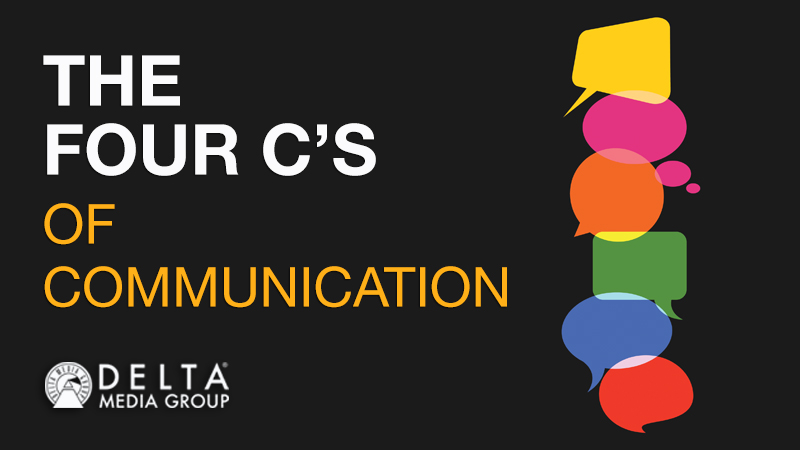
The Four C's of Communication
I have been contemplating the importance of relationships in both my personal and professional lives lately. So about a week ago, I decided to revisit a century-old book that I had read a couple of times before. Since my time seems to be in short supply these days, I decided to try and find an audio version of the book so I could listen to it while I worked out. I quickly found that a revised version of the book had recently been released and was available in an audio version, so I downloaded it and started listening.
What book is so good that I felt the need to read it a third time? How to Win Friends and Influence People: Updated for the Next Generation of Leaders by Dale Carnegie.
Ironically, that same week that I started listening to a book about communication, I had my monthly Vistage meeting, and the author and consultant we had gave a presentation to our group titled "Leadership, Conversations and Results," which was essentially about communication.
This got me thinking about all the important things that I have learned in the past 30 years about communication. Thinking about all the books I read, all the authors and consultants I've heard speak, and all the advice I've received from respected business friends, I created a long list that I titled "What have I learned about communication over the years?"
From my list of important things that I learned about communication, I looked for the four most important aspects and made another personal list that I titled "What should the communication of a leader be…the four c's of communication."
So, in no particular order, here are my four c's of communication:
1. Communication Should be Causing
When we communicate, we should cause something good to happen inside the people we are communicating with. Words that come to mind when I think of the word "cause," as it relates to communication, are: inspiring, encouraging, exciting, uplifting, moving, and motivating.
Even when sharing words that may be tough to hear we can always do it in ways that are causing others to be more than they are. Think of someone that did something wrong that you need to deal with. Even situations that require discipline can be used as teachable moments that cause people to be more than they are.
I love the quote from Zig Ziglar where he says, "If you aim at nothing, you will hit it every time." What are you aiming at with the people you lead? Are they inspired by you?
2. Communication Should be Calming
Even in times of peril, when we communicate as leaders, our communication should be calming to those we are communicating with. I immediately think of leadership communication and times when something bad may be happening and how, especially in those times, what and how we communicate is important. This is true when the people you are leading feel your leadership. When I think of the word calming I also think of these words: soothing, reassuring.
I love the leadership communication thought, "In the absence of information, people assume the worst." I don't know who first made this statement but I have heard it from countless authors and speakers and have found it to be true. I have, at times, communicated too little and have had others fill in the gaps in my communication with worse things that were not true. It is so important that our communication as leaders is calming; it's our job to ensure that it is.
4. Communication Should be Commanding
I need to be careful with this one because it immediately sounds authoritative to me but what I mean by commanding is best summarized by these words: leading, assertive, decisive, clear.
Basically, do our words carry good authority?
Something I feel best illustrates this concept is an old commercial I saw when I was maybe seven or eight years old that I still remember to this day, and maybe you do too. Do you remember the television commercials from E.F. Hutton in the late seventies or eighties? The phrase I think of from those commercials is, "When E.F. Hutton talks, people listen." Everyone immediately stops what they are doing and listens in because they want to hear what E.F. Hutton has to say because it is so important. This is the effect your communication should have as a leader.
4. Communication Should be Careful
I likely am not alone in this. Over the years, I have said things and immediately thought "I should not have said that." Those moments, more than anything, have taught me tough lessons of being careful with how and what I communicate. A good exercise in personal communication as it relates to how and what you communicate is thinking about the following words: wise, mindful, accurate, deliberate, prudent, and thoughtful.
I have had to rethink how I communicate with people over the years. A common practice of mine, when I was much younger, was to not look away from my computer screen when an employee would come into my office to ask me a question. I would find myself answering their questions and never once looking away from my computer screen. How embarrassing and unthoughtful! But, before you judge me, how many of us still do the same thing today when we are using our smartphones?
I love the quote from Mark Twain where he says, "It is better to keep your mouth closed and let people think you are a fool than to open it and remove all doubt." Sometimes careful communication means saying nothing, and sometimes saying nothing communicates volumes!
If you have not yet read Dale Carnegie's book, I encourage you to do so. The new release of his book, How to Win Friends and Influence People: Updated for the Next Generation of Leaders is a timely reminder to me how important communication is and how each of us can improve our communication skills.